Leading technical teams across large geographies like APAC requires a tricky balancing act: thinking strategically while staying tactically close to the technology. Nowhere is this dichotomy more apparent right now than in Data and AI. It feels like a month in AI is comparable to a year in other disciplines—and that time-compression factor is only getting more exaggerated.
It’s never been easier to use AI, but the dangers of abdicating our thinking are everywhere. With the explosion of synthetic content across every conceivable medium, "AI slop" is a very real problem.
For technical leaders, the antidote to this deluge of synthetic noise isn't to step back—it's to get hands-on. Genuine insights rarely come from simply reading about AI; they arise from testing these tools at the coalface to discover where they truly augment our capabilities.
Here are three key areas where I’m currently applying AI to augment elements of my professional and personal life:
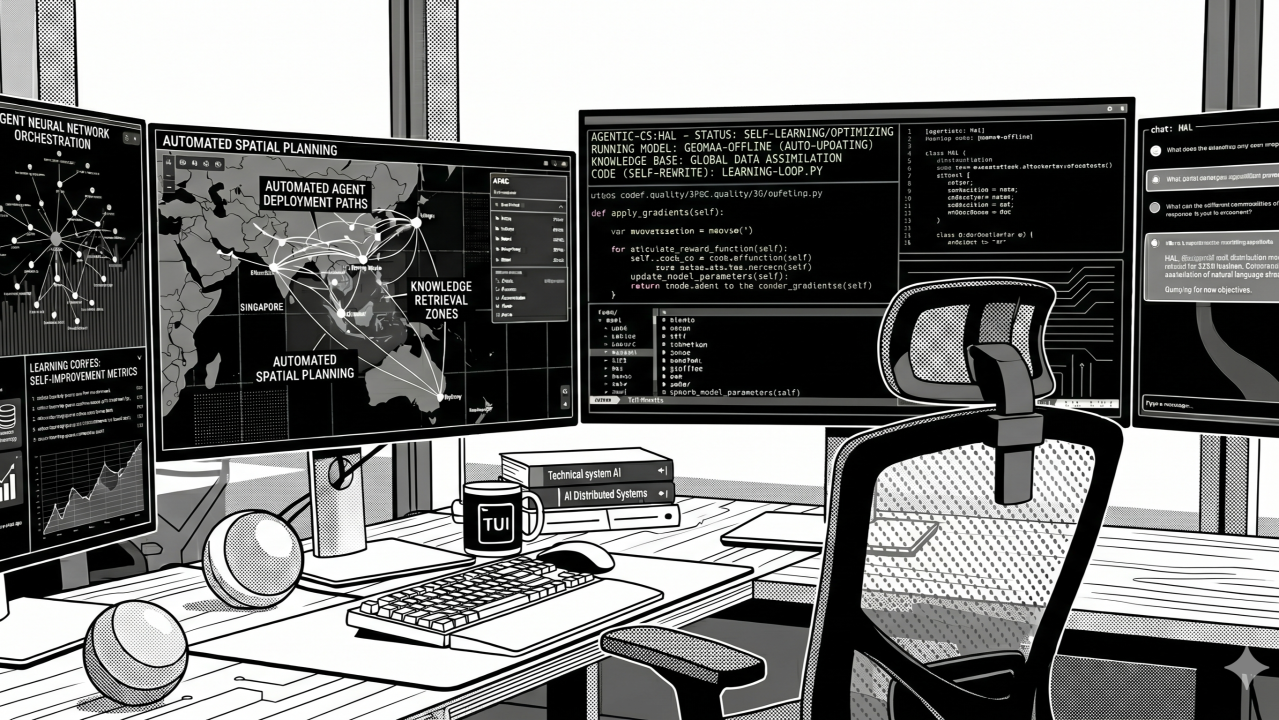
🤖 1. A Personal Agentic OS & Micro-Learning For the last three months, I’ve run an autonomous open-source AI Agent framework for personal use. I affectionately refer to it as Hal (and yes, so far, it has always opened the "pod bay doors" when asked). Hal filters personal emails, manages focus initiatives, and tracks tasks and projects.
The killer feature? A micro-learning skill I built. Hal captures book insights into a personal library and sends me daily questions, acting as an automated spaced-repetition system. The stack: Initially, Anthropic’s Sonnet and the open-source GLM 4.7-flash were my go-to models. Recently, Google’s Gemma4 has replaced GLM for offline tasks—its performance efficiency on modest server hardware is incredibly impressive.
📝 2. Meeting Notes & Action Capture Whether I’m interviewing a candidate, having a 1:1, or sitting in an account team meeting, the ability to review and analyse meeting transcripts and auto-capture actions is a game-changer. It allows me to be entirely present in the conversation rather than scribbling down notes. It’s easier to spot patterns, objectively answer questions, and make better decisions when you aren't playing stenographer.
🛠️ 3. Tool Building & The TUI Renaissance I haven’t written production code in years, but I’ve always loved building small tools to automate repetitive tasks. In the past, that might eat up half a weekend. Now? With agentic coding agents like Aider and Pi, I can create a basic tool during a coffee break.
Need an app to analyse the completeness of SFDC opportunity updates? Done. Need a conversational interface for my personal knowledge base? No problem—and it only costs a few pence.
(Side note: As someone who never strayed far from text-based editors like Neovim, I am absolutely loving the Terminal User Interface (TUI) renaissance we're seeing right now).
AI is rapidly marginalising the cost of execution. If you have an idea for a new tool, provided you can clearly define its purpose and align it with a coding agent, the barrier to building is little more than paying for tokens.
The “How” has become commoditised. It’s now entirely about the “What” and the “Why.” It has never been more important to think carefully about what you are choosing to do, and why you should do it in the first place.
(P.S. This post was mostly written by a human).