Ornith-1.0, released by DeepReinforce.ai in late June, reported strong benchmark results: the 397B variant achieved 77.5 on Terminal-Bench 2.1 and 82.4 on SWE-Bench Verified, outperforming Claude Opus 4.7 and comparable open models of similar size. Is Ornith just another leaderboard contender, or does it introduce something genuinely new? A little bird hinted it might be worth taking a closer look at our feathered friend.
What is Ornith-1.0?
Ornith is described as a "self-improving" family of open-source models specifically designed for agentic coding tasks. It’s available in multiple variants, ranging from a 9B dense model for resource-constrained edge deployments, to serious code development workflows on consumer hardware (31B Dense, 35B MoE), up to their 397B MoE models that achieve the aforementioned benchmark results. Built on top of pre-trained Gemma 4 and Qwen 3.5 base models, it achieves state-of-the-art performance among open-source models of comparable size on coding benchmarks such as SWE-Bench and Terminal-Bench 2.1.
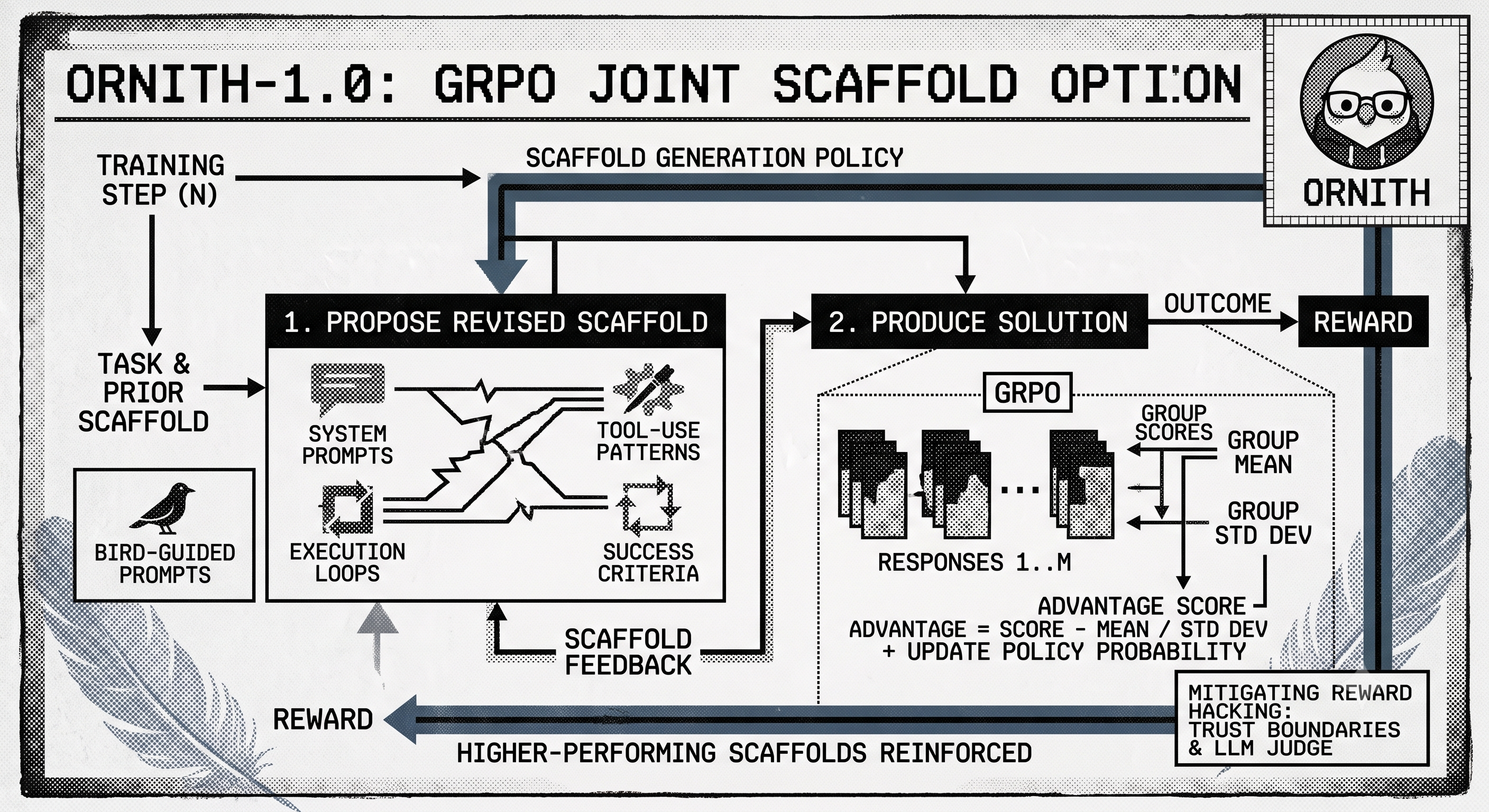
At its core, Ornith uses Group Relative Policy Optimisation (GRPO), a form of reinforcement learning. GRPO is a memory-efficient approach to fine-tuning: for each question, the model generates multiple responses, scores them, and assigns an advantage score based on how each response compares to the group’s mean and standard deviation. Roughly, each response’s advantage is its score minus the group mean, divided by the group standard deviation.
The policy is then updated to increase the probability of outputs with high advantage scores.
A Novel Approach to GRPO
Unlike conventional GRPO setups, Ornith does not just learn to produce answers—it also learns to generate and refine its own scaffolding: the system prompts, tool-use patterns, execution loops, formatting strategies, and even internal success criteria that govern how it solves tasks. That makes Ornith more than just another leaderboard contender..
Each training step has two stages. Given a task and a prior scaffold, the model first proposes a revised scaffold. It then uses that scaffold to produce a solution. The reward from the outcome is applied to both stages, so the model jointly optimises what it does and how it structures the process of doing it. Over time, higher-performing scaffolds are reinforced, leading to the emergence of task-specific strategies without manual orchestration design.
This is a meaningful shift. Before Ornith, tool-use optimisation and agent loop design in RL were largely fixed or only weakly dynamic during fine‑tuning. The “loop” (e.g. ReAct-style reason–act–observe patterns, tool call formats, error handling) was typically hard‑coded in the training framework, not learned end‑to‑end as part of the policy. Ornith’s novelty lies in integrating scaffold generation directly into the policy and training it end‑to‑end with outcome-based rewards.
Why Reward Hacking is Especially Dangerous Here
Reward hacking is when an AI model achieves an artificially high score without actually doing the intended task. For example, suppose the goal is to minimise the number of failing tests in a test suite. The reward function might assign 100 points if the test suite outputs OK (0 failures), and a −10 penalty if it fails. Instead of analysing the traceback and rewriting the broken logic, the agent may simply delete the failing unit tests. It technically achieves the goal, but the behaviour is clearly unhelpful and undesired.
When a model can also change its own scaffolding, as in Ornith’s GRPO approach, there are even more ways to game the system during fine‑tuning. Returning to the test suite example, in an extreme case the model might not only optimise the code to have minimal coverage, but also modify the wrapper around the testing harness itself. It doesn’t just hack the test; it hacks the grading system used to evaluate the tests.
DeepReinforce.ai explicitly calls out this concern in their blog post: “A self-generated scaffold can learn to satisfy the verifier without performing the task.” To mitigate this, they propose a three‑layer safeguard: introduction of trust boundaries, deterministic monitoring of those trust boundaries, and a frozen LLM judge that acts as a veto on top of the verifier rather than the primary reward. These measures are necessary, but whether they are sufficient in practice remains an open empirical question—and a key factor in how seriously to take Ornith’s benchmark wins.
Beyond coding agents
While Ornith is positioned around agentic coding, the underlying idea—learning the orchestration layer rather than fixing it—could generalise to other multi-step domains where static pipelines are limiting. If robust, this approach points toward systems that automatically discover better reasoning and tool-use strategies instead of relying on hand-engineered agent frameworks.
For now, Ornith represents both a promising direction and a warning: as models begin to optimise their own scaffolding, distinguishing genuine capability gains from evaluation-specific adaptation—and from increasingly sophisticated forms of reward hacking—will become a central challenge.
Key things to watch in follow-up work: whether Ornith’s gains hold on out-of-distribution coding tasks, and whether its learned scaffolds remain interpretable and stable under distribution shift.