For years, running a truly autonomous coding agent on a modest consumer GPU felt out of reach. With Qwen3.6-35B-A3B and the Pi agentic harness, I saw a level of capability that surprised me. But when DeepSeek-V4-Flash-0731 was released on Friday, the benchmarks suggested it was now a viable option. After putting it through its paces on Saturday afternoon, I can confirm the capability is real — but it also consolidated my thinking about when it makes sense on consumer hardware.
The Evolution: From Babysitting to Autonomy
My first serious local coding model was GLM 4.7 Flash. It was the first time I could get an agent to reliably develop small, clearly defined functionality. That said, it would still occasionally get stuck in a thinking loop and require me to step in. For more complex tasks, I would always need to pivot during the development process and switch to a commercial model like Sonnet or Gemini. It was useful, but not autonomous, and it would often make suboptimal decisions during the planning stage.
Then came Qwen 3.6-35B. This changed the game for me. It was not only a competent general-purpose agentic model, but when paired with the Pi coding agent harness, it required far less intervention from me. I could get alignment using a skill like "grill-me" and then focus my attention on other activities, checking in every 10 to 15 minutes to monitor progress. It still occasionally got stuck in a loop or required multiple attempts to implement some functionality, but overall it did a competent job — provided I kept the context window below 100k tokens.
DeepSeek-V4-Flash-0731 took things significantly further. Unsloth’s range of quantised models offers plenty of options for consumer hardware. I started with their 3-bit quantisation as a safe starting point for my modest rig, then quickly adopted the UD-ID4-XS variant. After building a clear plan, I let it work on the development. I checked in three times during the afternoon, and it only required my intervention once. A cursory scan through the development log showed no notable errors or repeated attempts at a particular task. This was unexpected.
So, Can You Replace Commercial Models on a Modest Home Rig?
For simple coding tasks, the answer is increasingly yes. But here’s the catch: unless you are working under strict enterprise NDAs, most hobbyists and indie developers do not actually need the privacy of local development. The software we write rarely contains intellectual property that requires that level of protection.
So why go local? The main draw is sunk cost. If you already own the hardware, you are not paying a monthly subscription or per-token fees.
The Real Math: Trading Time for Cents
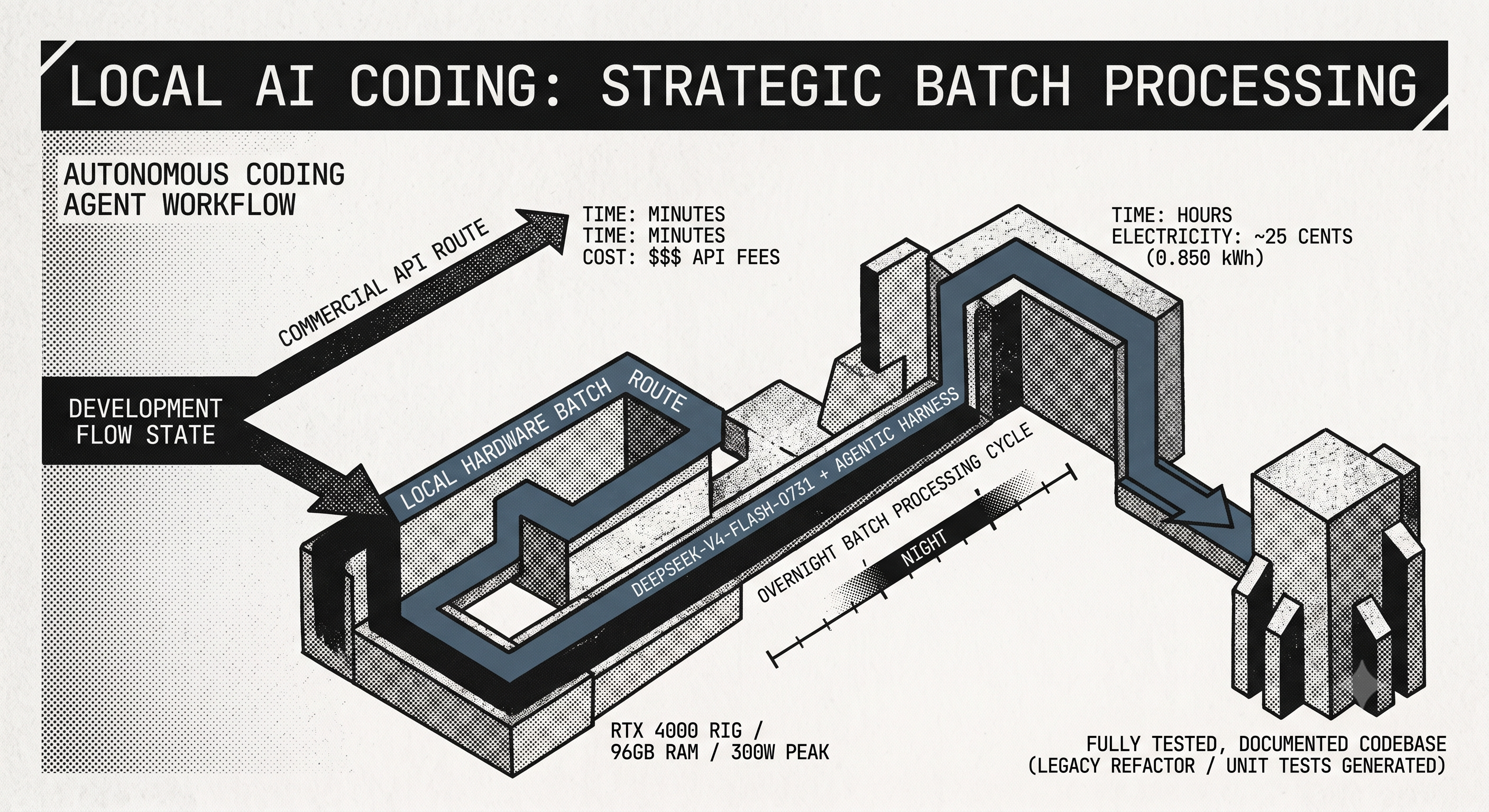
But there is a catch. If you spill weights to the CPU, which drastically bottlenecks speed, a large model running on consumer hardware can take hours to complete a task that a commercial API might finish in minutes.
Let’s look at the actual running costs. My home rig, an RTX 4000 GPU on a host with 96 GB of CPU RAM, averaged around 300 watts during testing. Over the course of an entire afternoon, it consumed approximately 0.850 kWh. At $0.30 per kilowatt-hour, that works out to about 25 cents in electricity.
A competent commercial model might charge you a dollar or two in API fees for the same workload. So yes, running locally is technically cheaper. But you have to ask yourself: if you are sitting at your desk actively waiting to test a new feature, is saving $1.75 worth waiting three extra hours for your code to generate?
The real cost here is opportunity cost: minutes versus hours.
The Verdict: The Power of the Batch Job
Does this mean I will not use local models for development work? No. They are great for batch processing that needs reliability but not speed. Since I moved to interacting with OpenClaw over Telegram, I have realised that most of the time I do not actually need a quick response. I can go about other tasks and get notified when the work is complete. It is only when a task pulls me out of a flow state that waiting for a slow agent becomes a problem.
So when does a local model make sense? Think about generating extensive unit tests for a codebase, writing docstrings for undocumented legacy code, or performing a large, repetitive refactor.
Instead of paying a commercial API to read 50 files and write boilerplate tests, you can use DeepSeek-V4-Flash-0731’s large context window and let it do its thing. Kick off the agentic harness before you go to sleep, let your GPU chug along at 300 watts all night, and wake up to a fully tested, documented codebase that cost you less than a dollar in electricity.
Local AI coding has arrived, but it is a strategic choice. Use commercial APIs for speed when you are actively in the flow state, and leverage your local hardware as a tireless, cost-effective overnight worker for everything else.