People often argue that AI, like many of the technologies that preceded it, will simply augment the workforce—and while some jobs will be replaced, many new jobs will be created.
I agree with that broad view, but I think it misses something important: AI is no longer just a tool that analyses data or predicts outcomes. In some domains, generative and agentic systems now produce work, carry out multi-step tasks, and amplify the output of human teams. That shift will create new businesses and opportunities, but it also changes how we should think about skill, oversight and meaningful work.
The most consequential shift may be that AI is no longer just executing ideas, but increasingly helping produce them — and perhaps, one day, helping originate them.
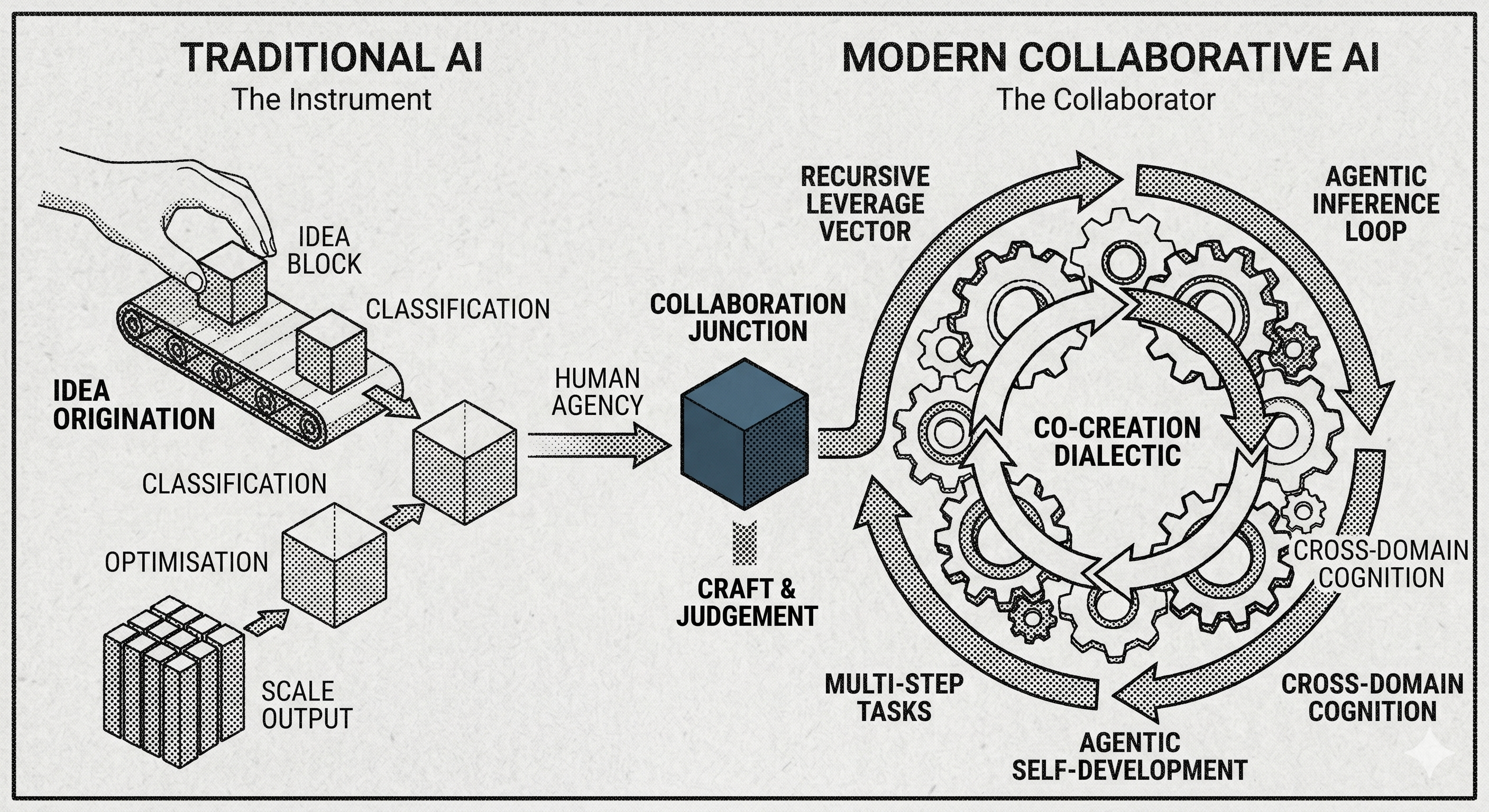
What makes this especially significant is that modern AI is not merely analytical in the traditional sense. Traditional AI classified, predicted and optimised. Generative AI creates. Agentic AI can act on that creation with increasing autonomy. That combination makes modern AI feel different from the technologies that came before it.
From the printing press to the combustion engine, from the microchip to cloud computing, each breakthrough expanded what humans could do. But they remained, fundamentally, instruments. AI is beginning to feel different. In the best case, it is not just a passive tool we use to scale our own ideas, but an active collaborator that helps shape them.
I experience this shift from two distinct angles. First, as a development partner. When I use tools like Pi together with powerful frontier models to architect and write code, AI is actively reasoning and helping with creative problem-solving alongside me. Second, I see it as an agentic platform that increasingly evolves through use. By interacting with my workflows, it can adapt, extend its capabilities and create new forms of leverage.
At the frontier of research, we are already seeing signs of this transition. Some AI systems are now materially contributing to their own development, with reports that Claude authored more than 80% of the code merged into Anthropic’s production codebase in May 2026, and that engineers were able to merge far more code than before as autonomy increased. That does not mean AI is fully self-improving in the science-fiction sense, but it does suggest we are moving into a world where AI is increasingly involved in building the systems that build it. That is a meaningful change.
The implications are vast. We are likely to see automation move higher up the knowledge-work stack, but the deeper question is not simply what gets automated. It is what happens to human agency, judgment and craft when machines increasingly participate in the creative and structural work of innovation.
As AI becomes more capable, we will need to make careful decisions about what we outsource and what we keep for ourselves. We should think not only about productivity, but about the kinds of work that help us grow, stay sharp and find meaning. The goal should not be to set the vision and curate the output while losing the experience of making. It should be to use AI to expand what is possible, without giving up the parts of work that make it worth doing and meaningful.